
What Is Integrative Pelvic Therapy?
- Andy Turner

- 2 days ago
- 10 min read
Integrative pelvic therapy is a whole-body approach to pelvic health that treats a pelvic symptom, like leaking, heaviness, or pain with sex, as one signal of a larger picture rather than an isolated mechanical problem. It combines hands-on pelvic floor work with nervous-system and somatic care, naturopathic and herbal medicine, manual manipulation, and therapeutic yoga, held together in one plan by one provider.
I'm Dr. Andy Turner, ND, in Portland and I provide this care as a naturopathic physician trained in integrative pelvic floor therapy. The model looks at the whole system around a symptom: the muscles and fascia, yes, but also hormones, the nervous system, posture, and the emotional weight a person is carrying. Most people would need three or four separate providers to assemble what one integrative plan can hold, and my new patient visits run a full 60 minutes so there's room to see the whole picture before we touch a single treatment.

How integrative pelvic therapy differs from pelvic floor physical therapy
This is the question most people are really asking. Pelvic floor physical therapy is the conventional, first-line standard of care, and it works well. A pelvic floor physical therapist retrains the muscles, coordination, and mechanics of the pelvic bowl, and for many people that biomechanical work is exactly what's needed. If you've been referred and you're wondering what the integrative version actually feels like, my post on what to expect when you've been referred to pelvic floor physical therapy walks through a visit with me, start to finish.
Integrative pelvic therapy is a different, broader model, not a better one. It shares many of the same manual tools, like myofascial release and trigger point work, and then widens the lens to the rest of the body. A pelvic symptom becomes a starting point for looking at hormones, the autonomic nervous system, sleep, stress, posture, and history, because those systems shape how the pelvic floor behaves.
Here's how the two compare:
Pelvic floor physical therapy | Integrative pelvic therapy | |
Primary focus | Muscle mechanics and coordination of the pelvic floor | The pelvic floor as one part of a whole-body and nervous-system picture |
Common tools | Manual therapy, biofeedback, exercise, muscle retraining | Manual therapy plus nervous-system work, herbal medicine, joint manipulation, and therapeutic yoga |
View of the symptom | A local mechanical issue to rehabilitate | A signal that can involve hormones, stress, posture, and emotional history |
Who provides it | A licensed physical therapist | A naturopathic physician trained in integrative pelvic floor therapy |
Pacing | Structured toward functional goals | Trauma-informed and consent-based, paced to the person |
Both belong in good pelvic care. I work alongside pelvic floor physical therapists, and I refer to them when a case calls for more support or a broader care team, or when it involves something I don't treat, like male pelvic floor therapy.
The conditions integrative pelvic therapy addresses
Integrative pelvic therapy supports women and gender-diverse people with a wide range of pelvic concerns, including pelvic pain and pressure, urinary leakage or urgency, pain with sex, chronic vulvar pain, prolapse, postpartum recovery, painful or heavy periods, and endometriosis-related pain. A few of the clinical terms are worth defining plainly, since people often arrive having heard them without a clear explanation.
Dyspareunia is recurrent or persistent pain with intercourse or penetration.
Vaginismus is the involuntary tightening of the muscles around the vaginal opening during attempted penetration, which can be extremely painful.
Vulvodynia is chronic vulvar pain without an identifiable cause, most often described as burning.
Vestibulodynia is the localized form of vulvodynia, where the pain sits in the vestibule, the tissue right around the vaginal opening. It is the reason tampons, exams, and sex can hurt when everything looks normal.
Cystocele is anterior vaginal wall prolapse, where the supportive tissue weakens and the bladder descends into the vaginal canal.
Rectocele is the same kind of support problem on the back wall of the vagina, where the rectum bulges forward.
Stress incontinence is leaking with coughing, laughing, sneezing, or exercise, when the muscles and tissues supporting the bladder and urethra are not holding.
Urge incontinence is a sudden, hard-to-stop need to urinate, sometimes with leaking on the way to the bathroom.

These concerns are common. The American College of Obstetricians and Gynecologists reports that pelvic organ prolapse affects about 1 in 4 women in their 40s and 1 in 3 in their 60s, rising to half of women by their 80s, and stress urinary incontinence is one of the most common pelvic complaints, especially with age and after childbirth. Common does not mean you have to live with it, and it does not mean the answer is always the same.
Why pelvic symptoms are not only mechanical
A tense or painful pelvic floor is often the body doing its job a little too well. When the nervous system reads threat, whether from stress, pain, or past trauma, it can hold the pelvic muscles in a protective, guarded state. Over time that guarding becomes chronic tension, and chronic tension creates its own pain.

The research points the same direction, though the evidence base here is still small. In one study of women screened for traumatic events, only those who had gone on to develop post-traumatic stress symptoms showed higher pelvic floor muscle activity. This is why I don't start every plan with hands-on internal work. For some people, the first step is helping the nervous system feel safe, through breathwork, grounding, and gentle external care. My guide to diaphragmatic breathing for the pelvic floor is a good place to feel how this works. Any internal or pelvic work happens only with your explicit consent, every time.
Why Kegels are not always the answer
Kegels get recommended for almost everything, and for a weak or under-supported pelvic floor they can genuinely help. For an overactive, non-relaxing pelvic floor, they can make things worse. Asking an already-tense muscle to keep contracting does not address what is actually happening. In non-relaxing pelvic floor dysfunction, instruction in relaxation and coordination matters as much as strengthening.

That's why a good plan starts by figuring out whether your pelvic floor needs strengthening or relaxing. When the issue is tension, I focus on lengthening and downregulating: breathwork, targeted stretches, and positions that let the pelvic floor release. This is where yoga earns its place in the toolkit.
The tools in an integrative pelvic therapy plan
No two plans look the same, but they're usually built from the same set of tools. Here's what each one does and where it fits.
Manual therapy and visceral work
Hands-on techniques like myofascial release and trigger point therapy address the muscle and fascial patterns that hold pain. Gentle uterine and abdominal massage supports circulation and fascial ease in the pelvis and lower belly, and visceral work can help mobilize the organs of the abdomen. I'm honest that this work isn't a stand-alone treatment; it layers into a broader plan, and internal techniques are used only with consent.
Joint manipulation
Pelvic symptoms often ride along with alignment issues in the sacrum, low back, or pelvis. As an Oregon-licensed naturopathic physician, I can evaluate and perform manual therapy and joint manipulation, including higher-velocity adjustments, directly as part of your care and without an outside referral. When alignment is contributing to a pain pattern, addressing it can take pressure off the pelvic floor.
Nervous-system and somatic work
Calming an activated nervous system is often the real work. Tools here include progressive muscle relaxation, guided meditation, breathwork, and Embodied Alignment, a body-based somatic session for processing grief, tension, and disconnection. These are low-risk practices, and I pay close attention to what patients tell me about how they respond. When something is helping and carries little to no risk, that experience carries weight in your plan.
Therapeutic yoga
I've practiced and taught yoga for more than 20 years, and it's woven into how I approach the pelvic floor. Many pelvic floor exercises overlap with yoga: core work, hip mobility, and hip strengthening are core to both. For a tense pelvic floor, I may skip Kegels entirely and prescribe poses that lengthen the adductors, open the hips, and let the belly and pelvic floor soften. For prolapse tied to pelvic misalignment, yoga can help balance muscles that are overworking on one side and underworking on the other, which supports better posture and eases the pain patterns that follow. In people with chronic pelvic pain, yoga shows measurable improvements in pain and quality of life. My Yoga as Medicine visits build this into a full plan.
Herbal medicine
Botanicals can support the systems around a pelvic symptom, and I use them with clear boundaries about what they can and can't do. To calm a stress-driven, muscle-tightening pattern, oral nervines like ashwagandha, skullcap, and valerian may support nervous-system regulation. All three interact with the GABA system, the signaling pathway your body uses to help the nervous system quiet down. The clinical evidence for each is still limited, which is why I treat them as one part of a plan rather than the plan itself.
Herbs interact with medications, so I review everything you're taking before I recommend anything. Adaptogens like ashwagandha alongside an SSRI is exactly the kind of combination worth looking at closely, and that safety-versus-benefit check is part of every visit rather than an afterthought. Pregnancy and breastfeeding change the calculation too. Ashwagandha should be avoided during pregnancy and while breastfeeding, and valerian has not been studied enough in either to call it safe, so those plans get built differently.
For prolapse, botanical astringents like horse chestnut are traditionally used for pelvic support, and I want to be clear about what the research actually covers. The clinical evidence for horse chestnut sits in chronic venous insufficiency, where it improves leg pain and swelling, not in prolapse. What carries over is the thinking about vascular congestion and tissue tone, so I use it as one supportive layer inside a broader plan rather than as a treatment for prolapse on its own.
On the topic of steams: vaginal or yoni steaming comes up often, and I do recommend it for the right person. I won't overclaim a tissue-level effect. What it offers is quieter and, in my experience, more useful than that. It downregulates the nervous system and brings focused, positive attention to a part of the body many people have spent years bracing against or ignoring. Think of it as meditation with a location. Done well, the steam should feel warm rather than hot, with enough distance that nothing touches the tissue. A warm sitz bath with properly diluted herbs works in a similar way and is easy to do at home.
What integrative pelvic therapy looks like in practice
The clearest way to explain the model is to show how it holds a whole person. In my practice, I often see patterns like these. Both are composites, not any single patient.
A trauma-informed, slow-build approach
Someone comes in with pain right at the vaginal opening, a lifelong inability to use tampons, and discomfort even wearing certain clothing. My first job is to rule out acute and anatomical causes: I check for active infection with a swab, and I consider anatomical differences and prior physical trauma. For some people, the roots trace back to past sexual trauma, and the body has learned to guard.
With a history like this, hands-on pelvic work is often off the table at first, because it can trigger too much of a trauma response. The first several visits might be mind-body work: breathing techniques, progressive muscle relaxation, guided meditation, and gentle bodywork or energy work to help downregulate the nervous system. From there we might progress to abdominal and uterine work, then toward external pelvic floor work, and eventually to internal work only when it's tolerated and only with consent. Alongside the hands-on care, we tend to the foundations of nervous-system regulation: relationships, food, movement, and sleep.
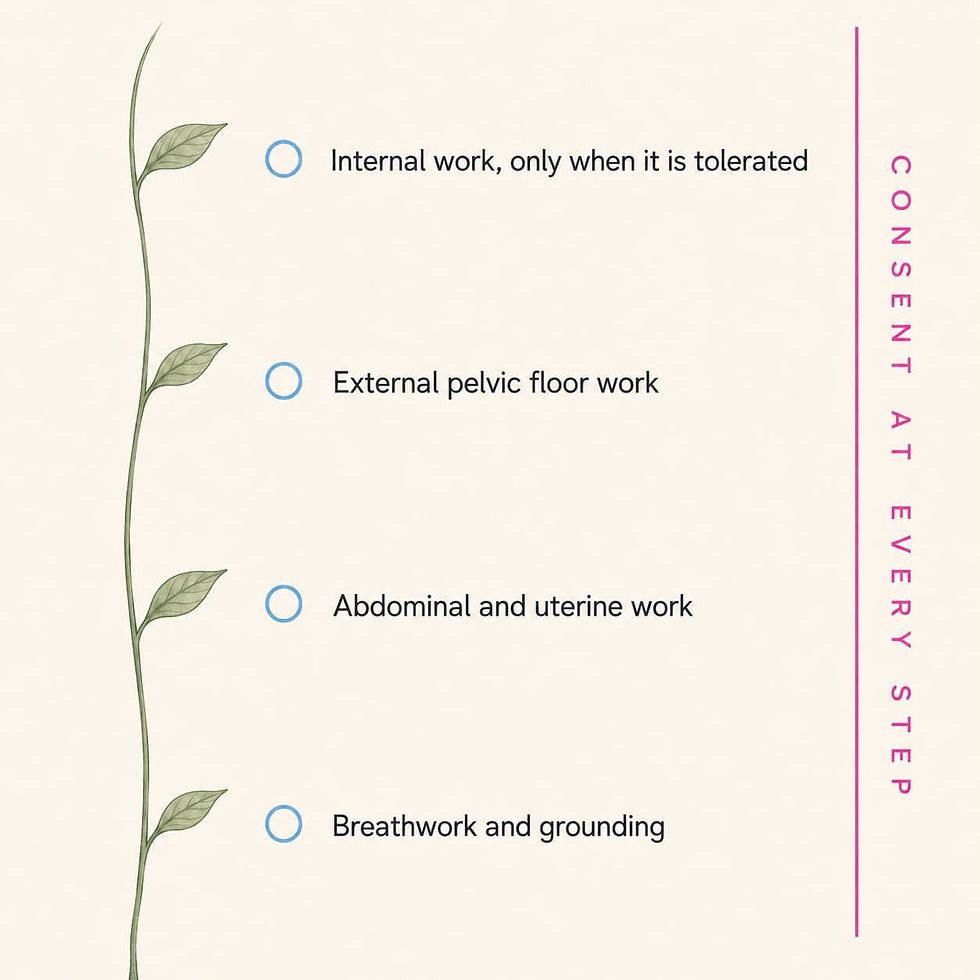
The whole process leads with trust and safety, and it builds toward real goals. Sometimes that goal is being able to get through a needed Pap smear that a trauma response has made impossible for years. One patient's published review still means a lot to me: "Seriously the best PAP I've ever had."
A whole-person approach to prolapse and leaking
Another common pattern: a parent, several pregnancies in, dealing with a cystocele that feels heavy, urine that leaks more and more, and intercourse that's become uncomfortable. On the physical side, options may include manual pelvic therapy with myofascial and trigger point work, visceral manipulation to help lift and support the organs, and botanical astringents for supportive relief. In my practice, this combination often improves both the symptoms and the underlying support over time. Part of my job is also assessing whether a prolapse needs more than this, and I'll say plainly when a pessary fitting or a surgical referral is the right call.
I also pay attention to everything around the physical symptom. Often a person in this pattern is genuinely unsupported: new to the city, far from family, stretched thin, and not yet asking for help. I use behavioral approaches to help name that need and build real support, whether that's a parents' group, a neighborhood connection, or a weekly walk with another parent. Physical recovery tends to go further when the emotional and social layers get attention too. For postpartum patients, my writing on holistic pelvic care after childbirth and my postpartum care page cover this in more depth.
One provider, one plan
What makes this model work is continuity. At AndyND, one provider delivers the full combination: naturopathic primary care, integrative pelvic floor therapy, uterine and abdominal massage, herbal medicine, and yoga therapy. I trained in integrative pelvic floor therapy under Dr. Kathryn Kloos, ND, and I hold advanced 300-hour and 500-hour yoga certificates on top of more than two decades of teaching. That means the person mapping your hormones is the same person doing the hands-on work and prescribing the herbs, so nothing falls through the cracks between offices.
A note on cost, because I believe in transparency. Some insurance plans cover integrative pelvic therapy alongside a standard office visit, so the hands-on work is billed together with the visit. If you're paying through my equity-based self-pay pricing, the hands-on work is included in the visit price with no additional fee. As of July 1, 2026, OHP and Regence patients pay a $30 to $60 sliding-scale fee per hands-on session, because both insurers stopped reimbursing the codes this care is billed under. Pelvic therapy is also course-based, meaning it usually takes a series of sessions rather than one visit, and I'm always glad to talk through options if cost is a barrier. You can see the full picture on my pelvic floor therapy page.
Frequently asked questions
Is integrative pelvic therapy the same as pelvic floor physical therapy?
No. Pelvic floor physical therapy is focused biomechanical care from a physical therapist. Integrative pelvic therapy is a broader model from a naturopathic physician that adds nervous-system work, herbal medicine, joint manipulation, and yoga to the manual therapy.
Do I need a referral for integrative pelvic therapy?
No referral is needed. You can bring one if another provider sent you, but it isn't required to begin.
Is internal pelvic work required?
No. Everything is consent-based, every time. Many plans start with breathwork and external work, and internal techniques are only used when you're ready and only with your explicit consent.
Can integrative pelvic therapy help with prolapse?
Yes. In my practice, prolapse symptoms and pelvic support often improve with a combination of manual therapy, movement, and botanical support. Part of my job is assessing whether a prolapse needs more than that, and when it does, I'll tell you honestly that a pessary fitting or a surgical evaluation is the right next step.
Let's talk
If you've been feeling a pelvic symptom and sensing there's more to the story than the mechanics, you're probably right. Integrative pelvic therapy is built to look at the whole picture and to move at your pace, with consent at every step. If you're weighing whether this model fits what you're feeling, I invite you to reach out and schedule a visit. Let's build a plan that fits your body and your life.


Comments